Designer Showcase

01/12/2008

Curiously clever fashion designer, Karim Bonnet


Karim Bonnet grew up in the Place de Clichy and attended Ecole Nationale de Chemie in Paris, where he was a strong student, attaining excellent results in maths, geometry, physics and biology. His curious transition from chemistry to fashion resulted from his love of sewing. By the age of 11, Karim was making cushions, by 15 years of age he was making curtains and embellishing jeans. His love of fashion influenced his friends at school: everyone copied him - as, it seems, they still do. By the age of 16 Karim realized that he had to work with cloth rather than chemicals. In 1989, he moved to a fashion college in Bastille.


The fabrics used for Karim’s Impasse de la Defense collections have changed over the years. Initially, he worked a lot with cotton, but was asked by his customers to start trying other fabrics. He now also uses more delicate fabrics, including parachute silk, which he sources from a friend who owns a vintage military shop. Karim explains that the production for each collection takes seven months in his head, followed by one week in the workshop! He feels “like an eagle, flying high up, making calculations and then pouncing down on a little animal” he sees below and catching it. He actually employs six people in his workshop – augmented to twelve at the time of the shows. He uses factories for quite a lot of the sewing, but all of the prints and the painting are done by hand at his workshop.

I first met Karim in 1998 and attended one of his mind-blowingly inspirational early fashion shows back in 1999. Now well established, though globally under-appreciated, Karim also works as a creative adviser to the French national railway company, SNCF. It was fitting that his fashion show this season, which opened Paris Fashion Week, was held at Le Train Bleu, an extravagantly decorated Belle Epoque style restaurant in the Gare de Lyon.

The inspiration for the Impasse de la Defense A/W 2008/9 collection was ‘psychogeographie’, defined in 1955 by Guy Debord as the "the study of the precise laws and specific effects of the geographical environment, consciously organized or not, on the emotions and behavior of individuals”. A study of psychogeographie makes interesting reading, for it is part serious geographic theory and part the drunken ramblingsof its key proponents. In their memoirs, Debord and fellow psychogeographer, Jorn, chose a metaphor for the landscape of a female body, updating it in the form of a paint-splattered collage of pin-up models.

The highly original choice of a socio-spatial theme provides for quite a lot of maps, signposts, arrows and directions to be featured within the printing and hand-painting on the garments in the Impasse de la Defense collection.
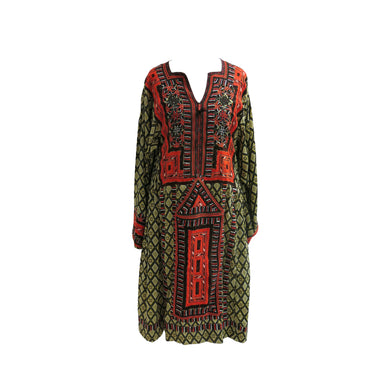
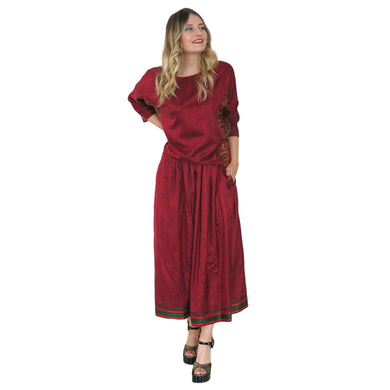
The architecture, especially steel in the buildings in Paris has always been featured in Karim’s work, but this season he’s moved away from the geometric lines of high-rise structures to the older more art nouveau inspired traditional French wrought iron work and balustrading used on balconies and doors, as seen on this parachute silk dress.


Karim’s own favourite places are, firstly Paris. When asked what he most likes about the city, he explains that it’s his girlfriend, who just happens to be a top model. Patriotically, his first child is called Paris and his second is named Lys (after Fleur de Lys). Curiously though, his other favourite place is Scotland – which possibly accounts for the preponderance of tartans in his collections and his own predilection towards checked fabrics – as modelled by him (above right) at Pret a Porter. Shortly afterwards he was descended upon by the Mayor of Paris and his entourage, who kept Karim talking for at least 20 minutes, whilst I tried to hide under a clothes rail.


Karim says that to understand what makes him curious you’d have to know him. However, he admits to loving curious names. He also divulges that “in Paris there are lots of curiosity shops. When you go inside, you don’t have to buy, you can look around simply for the pleasure of the eyes.” (Sounds just like the ShopCurious website). Karim’s ideal customers are “princesses and, one day, the Queen” – as well as his Mum, of course. Karim’s ideal dinner party guests would be Leonardo da Vinci (seated to his left) and Giocondo (to his right).

He’s already working on his dream collection for next winter, inspired by New York City in the 1940s, the energy of Spanish Harlem and James Brown. Finally, Karim informs me that he still remembers the time he kissed an English girl from Leeds. She had freckles… and Karim simply loves girls with freckles – so, if there’s a suitably befreckled female who wants to make a new friend, I’d suggest you give Karim a call. (I presume there’ll be no ‘impasse’ and no ‘defense’ from him either).

Thanks for letting us know that Karim…I’m sure it’s all part of your psychogeographie. We love your designs, anyway - definitely style with brains, if not pure genius!

05/11/2008

The curiously intriguing designer, Kacper Hamilton


Kacper Hamilton was born in London, where he grew up and went to Christ's Hospital boarding school from the age of 11. He spent most of his early years being creative whether it be drawing, sculpting or making things. Kacper wasn't interested in academic subjects and strongly believes he was brought into this world to work in the creative realm. However, when he was about 15, he started reading a lot of classical literature, which had a great influence on his life and work. This enabled him to “see the world from the past & present moment. I tried to live and design work which incorporated the best qualities from all of time. I wanted my life and my design to be timeless.”


Kacper went straight from school to study Product Design (BA) at Central Saint Martins College of Art & Design, where he learned how to design for a particular brief. It was here that he became more of a designer than an artist, although he very much likes to combine both art and design in his work. In the summer of 2007, Kacper was employed as a design assistant at the 'Fredrikson Stallard' studio in East London, where he was fascinated to learn how the prestigious design duo approach their work.

His last year of studies was by far the best and most rewarding, “I finally managed to set myself free and immerse myself in pure design”, he says. He was also fortunate to get the first set of his ‘Deadly Glasses’ sponsored by the Schott glass company. Since the first CSM show, the glasses have been shown at 100% Detail, Tent London and may soon be shown in Italy, Spain and France. They are now also exclusively available for sale via the ShopCurious website.

Now for some more about Kacper and his work: Kacper’s mother is an artist and he was “always led by the hand to different exhibitions and art private views. I came to love art and I then started becoming interested in design. I think design provides more opportunities, as you can be a commercial designer as well as a one-off piece designer. You have the knowledge to design products and furniture as well as being able to create art. I love the concept of design, as when you have the basics you can design and make anything that comes into your mind; your imagination is the only limit.”

Kacper also explains that “everything in life is curious for me. I believe every person in this world has their curious ways and habits. As a designer it is sometimes great to observe these strange habits and use them for inspiration in design. Perhaps I am curious as I am a person who is living in the 21st century, whilst my mind and soul are living in the 17th century. I am very inspired by the way of life in such past times, so I try and combine the good parts from all these different eras. I am traditional but perhaps slightly unusual in my appearance and formal and gentlemanlike in my behavior - for me this is normal but perhaps this makes me curious to others.” 


Kacper says he doesn’t have an ideal customer – “I don't like the concept of stereotypes” he says, “it’s too communist for my liking.”  His approach to design is very much akin to the ShopCurious philosophy of slow design.


He explains that he likes to approach his design in a traditional style, using high quality materials and products which are made by hand by experienced craftsmen. “This comes from my inspiration: the way of life in previous centuries, where cloths and furniture were bespoke and made to order. Everything was custom made so each person had some sort of involvement in the design process,“ he adds. He believes that now things are mass produced we have to make compromises by picking something ‘off the shelf’ and he thinks it’s sad that many mass produced items, especially in technology, are soon obsolete and replaced by a more modern, better or faster version. Kacper’s approach to design is very thorough, “paying attention to every detail and to make sure that all is executed perfectly. I like to use materials that are strong, durable and are of high class quality.” Every collection takes a different amount of time. At the moment I am working on a signature collection which I hope to complete and show within the next year. I always take into consideration where the materials I use come from and I like to find my materials and craftsmen locally, especially in England.”


As for the inspiration for Kacper’s work, he says that “at the moment most of my inspiration comes from classical literature, mainly from 17-19th century - especially by writers such as Marquis de Sade, Charles Baudelaire and Alexander Dumas. I am intrigued by the way of life portrayed and the etiquette and mannerisms involved. I normally pick up on a few things in a book, take a note of them and try and create some sort design related to that idea/philosophy.”


Kacper loves London “as it is the golden city of opportunity.” He also likes spending time in West Sussex in the countryside, whether it for a picnic or a game of golf “I just love the scenery. There are also many other places I am planning to visit soon such as Cuba & Japan.”  Kacper is currently setting up a small studio in London to work on his new collection. He’d also really like to collaborate with other designers, architects and fashion designers on larger projects. In addition, he has ambitions to design a golf course: “I am an absolute fanatic and would love to apply my style to the traditional world of golf”, he explains.

Given his choice of who to sit next to at a dinner party, Kacper says that his “number one choice would have to be the infamous Marquis de Sade. I am sure the conversation would be entertaining, controversial and of an indulgent and debaucherous nature.”

How curious. Thanks Kacper, I think that’s as much as we need to know for now.